Vehicle DIY Guide
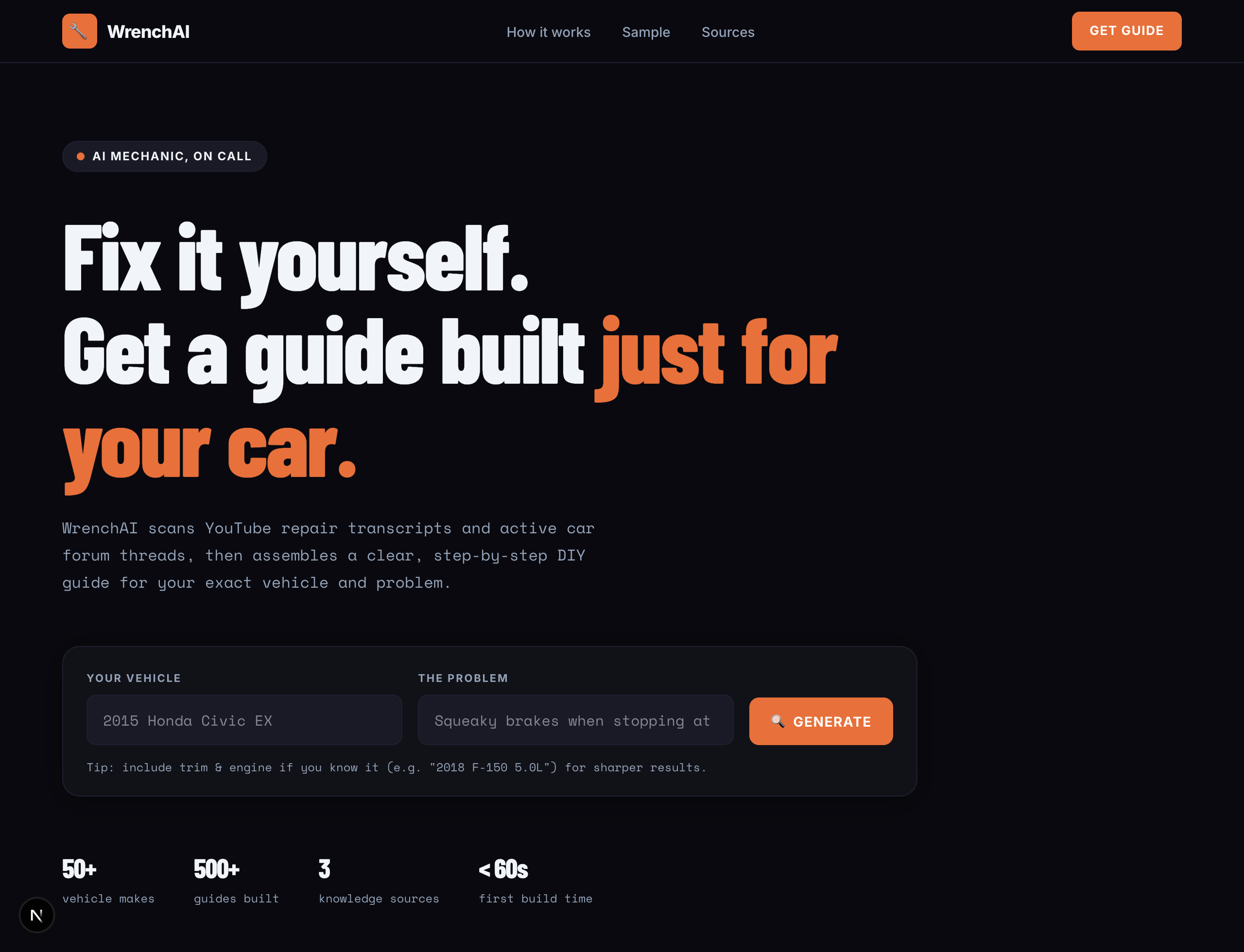
An agentic RAG system that builds vehicle-specific repair guides from manuals, forums and video — with a live AI mechanic you can ask follow-ups.
The problem
Generic AI answers are useless for car repair — the right steps depend on the exact year, make, model and engine. Owners need guidance grounded in real, vehicle-specific sources, not a plausible-sounding hallucination.
The approach
A knowledge-builder agent fans out across NHTSA technical service bulletins, Reddit (PRAW), YouTube transcripts and web search in parallel, then a synthesizer merges them into a single vehicle-specific, step-by-step guide with safety tiers. Guides are embedded and cached in Postgres+pgvector so repeat queries are instant and free. An intent-routed chat session lets the user ask real-time follow-ups grounded in the retrieved context.
Architecture
Vehicle input (year/make/model/engine + problem)
        │
        ▼
Knowledge-builder agent ── parallel ──▶ NHTSA TSB · Reddit · YouTube · Web search · Images
        │
        ▼
Synthesizer (Claude Sonnet) ─▶ safety-tiered, step-by-step guide
        │
        ├─▶ embed + cache ▶ Postgres + pgvector   (repeat queries = instant, $0)
        │
        ▼
Guide session (intent routing) ─▶ AI mechanic chat (Claude Haiku) grounded in retrieved context
Key decisions & trade-offs
- ▸Claude Sonnet for one-shot guide synthesis (quality), Claude Haiku for chat (cheap, fast) — cost-tiered by task.
- ▸pgvector over a hosted vector DB: one Postgres does storage + retrieval + caching, less infra to run.
- ▸Aggressive caching: a repeat request for the same repair is served instantly from the cache at no additional API cost.
- ▸Safety tiers classify repairs (cosmetic → mechanical) so the UI can warn before risky jobs.
Results / impact
- ✓Produces a vehicle-specific, safety-tiered guide in a single pass from 5 parallel sources.
- ✓Caching reduces repeat lookups to instant responses at no additional API cost.
- ✓Cost-tiered LLMs keep the price of each generated guide low without sacrificing quality.
Roadmap
- ▸Add vehicle-recall alerts sourced from the NHTSA feed.
- ▸Explore a scale-to-zero serverless backend (Bedrock) to cut idle hosting cost.